Well, I have been wanting to do this for a long time (procrastinator!) - so finally today I signed up with them :-)
Technorati Profile.
Thursday, December 14, 2006


Tuesday, December 12, 2006
Top 10 and 5 Fastest Growing Online Activities
New Internet activities such as blogs, video, and phone calls are the fastest-growing in terms of usage, while email, news/info, and online shopping continue to dominate Internet users' activities on the web, according to a report released by Mediamark Research, writes ClickZ.
Top online activities include e-mail (70.5 percent), reading news and current events (40.2 percent), and e-commerce purchases (34.2 percent).
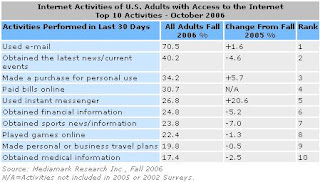
Voice over IP calling is the fastest growing activity online, with year-to-year increase of 197.7 percent. Visits to blogs increased 163.9 percent from a year ago while use of online video sites rose 123.7 percent over 2005.

The data are a portion of an extensive survey conducted by Mediamark Research in September and October. In-person interviews were conducted in the homes of about 26,000 respondents. The subset of data in this release is limited to respondents with Internet access, about 80 percent of the survey pool.
Top online activities include e-mail (70.5 percent), reading news and current events (40.2 percent), and e-commerce purchases (34.2 percent).

Voice over IP calling is the fastest growing activity online, with year-to-year increase of 197.7 percent. Visits to blogs increased 163.9 percent from a year ago while use of online video sites rose 123.7 percent over 2005.

The data are a portion of an extensive survey conducted by Mediamark Research in September and October. In-person interviews were conducted in the homes of about 26,000 respondents. The subset of data in this release is limited to respondents with Internet access, about 80 percent of the survey pool.
MySpace is No.1 in Page Views
Fox with MySpace is No.1 in Page Views, Surpassing Yahoo - ComScore
Yahoo’s page views were down 9% month-over-month in November, allowing MySpace owner Fox Interactive Media to take the overall lead in that category for the first time, according to comScore data highlighted in an emailed note today from UBS Investment Research. (reports GigaOM)
Yahoo still maintains its No.1 position based on unique visitors, with nearly 130 million in November, according to comScore data. Fox Interactive is in 6th place, after Time Warner (AOL), Microsoft, Google, and eBay.
Yahoo’s page views were down 9% month-over-month in November, allowing MySpace owner Fox Interactive Media to take the overall lead in that category for the first time, according to comScore data highlighted in an emailed note today from UBS Investment Research. (reports GigaOM)
Yahoo still maintains its No.1 position based on unique visitors, with nearly 130 million in November, according to comScore data. Fox Interactive is in 6th place, after Time Warner (AOL), Microsoft, Google, and eBay.
Personal Locator Services to Reach 20M Consumers by 2011
Personal locator services based on the GPS-enabled mobile phone will grow from their current low user-base of 500,000 in North America to a total of more than 20 million subscribers in 2011, according to a new study from ABI Research.
Such location-based services, recently launched as "family-finder" options by Sprint Nextel, Verizon Wireless, and Disney Mobile, have now been joined by a new offering from youth-oriented mobile operator Helio. Badged as the "Buddy Beacon," the service allows users of Helio's Samsung Drift handsets to build a "buddy list" and broadcast their locations to each other for display on GPS-linked maps.
"Helio's Buddy Beacon is going to be very popular," says ABI Research senior analyst Ken Hyers. "It's innovative. This is the first service of its kind in North America.
"First launched in South Korea and Japan, personal locator services could reach 34 million Asia-Pacific subscribers by 2011.
ABI Research's "Location-Based Services" report examines the market opportunities for LBS from a handset-based perspective, focusing on location technologies, operator deployment strategies, and GPS-enabled handset evolution.
Such location-based services, recently launched as "family-finder" options by Sprint Nextel, Verizon Wireless, and Disney Mobile, have now been joined by a new offering from youth-oriented mobile operator Helio. Badged as the "Buddy Beacon," the service allows users of Helio's Samsung Drift handsets to build a "buddy list" and broadcast their locations to each other for display on GPS-linked maps.
"Helio's Buddy Beacon is going to be very popular," says ABI Research senior analyst Ken Hyers. "It's innovative. This is the first service of its kind in North America.
"First launched in South Korea and Japan, personal locator services could reach 34 million Asia-Pacific subscribers by 2011.
ABI Research's "Location-Based Services" report examines the market opportunities for LBS from a handset-based perspective, focusing on location technologies, operator deployment strategies, and GPS-enabled handset evolution.
Video Game Industry is doing good
Video game industry retail sales jumped 34% in November to $1.7 billion from $1.3 billion last November, according to data from the NPD Group. Total hardware sales soared 69% to $771 million on the launch of long-anticipated Sony's PlayStation 3 and Nintendo's Wii.
- The portable Nintendo DS sold in the highest numbers, with 918,000 units.
- Sony's PlayStation 2 followed with 664,000 consoles sold.
- Microsoft's Xbox 360 sold 511,000 units.
- The $250 Nintendo Wii sold 476,000 units.
- The PS3, which retails for $500 and $600, sold 197,000 units
Worldwide, Both Sony and Nintendo expect to sell 6 million of their next-generation consoles by the end of March.
Software sales climbed 15% to $804 million from $702 million a year ago.
Here comes IPTV...
Seems like everybody's getting into IPTV, from Microsoft to AOL, Alcatel-Lucent to Deutsche Telekom to China Netcom. But do consumers really want it?
Well, to know the answer, just look at the numbers from Gartner:
Well, to know the answer, just look at the numbers from Gartner:
- By 2010 the number of households with IPTV is forecast to reach 50 million from 3 million in 2005
- revenues could rise even more sharply, to $13.4 billion from $399 million
IPTV Around the World
Servicec providers all over the world are are trying to figure out how to build a "Telco 2.0" that delivers TV, Phone and Internet services over broadband pipes.
On Dec. 4, Britain's BT Group launched its IPTV service, setting a target of signing up between 2 million and 3 million subscribers. AT&T, Deutsche Telekom, Telefónica, Swisscom , France Telecom, Korea's KT, and China Netcom are also in various stages of rolling out their own services.
It's not just the telcos that have a stake in this. Just about every major tech company wants a piece of the action. Alcatel-Lucent is joined by Microsoft, Hewlett Packard, and Cisco Systems as well as upstarts such as UTStarcom and China's Huawei. The rivalry is expected to help the market ramp up quickly.
IPTV relies on the same basic technology as streaming video over the Web except that the signals stay within the telco's network. If done right, IPTV shouldn't be all that different from the programs you're accustomed to viewing on cable or over the airwaves. Where IPTV has an advantage over standard broadcasts is its potentially limitless number of channels and instant, on-demand access to a vast library of content stored on a telco's servers.
Monday, December 11, 2006
VoIP Grew to 8.2 million Subscribers
Total subscribers to Internet-based telephone (Voice over-IP) services in U.S. grew 18% to 8.2 million in Q3 2006, more than doubling the figure in a year since 3Q 2005, according to market research firm TeleGeography.
TeleGeography predicted the market would grow by roughly 1.5 million subscribers in the fourth quarter to end the year with 9.7 million, or about 8.7% of the nation's households.
VoIP revenues are expected to reach $2.6 billion for the year, an increase of 250% from about $1 billion in 2005.
Top VoIP Providers, by subscribers, at the end of 3Q 2006:
- Vonage Holdings (1.95 million)
- Time Warner's cable TV business (1.64 million)
- Comcast (1.35 million)
- Cablevision (1.10 million)
Saturday, December 09, 2006
Internet Video Revenues - $7 billion by 2010
Annual U.S. revenues from Internet video services – spanning user-generated content to television shows and movies – will exceed $7 billion by 2010, according to Parks Associates.
“Major broadcasters, movie studios, retailers, and content aggregators are all experimenting with new ways to distribute video content online and attach advertising to their offerings,” said Kurt Scherf, vice president and principal analyst, Parks Associates. “The early results have been quite promising.”
According to the report Internet Video: Direct-to-Consumer Services, online distribution has boosted viewership and advertising revenues for current primetime television offerings and serves a strong differentiator in an increasingly fragmented market.
Read the Press Release
From the Analyst Blog:
Question: What's the revenue forecast for Internet video advertising?
Answer: Annual revenues for Internet video advertising in the U.S. market will grow threefold between 2006 and 2010 to approximately $4.4 billion in 2010. Most of these early advertising dollars will be generated from non-embedded display ads on different video streaming Websites. Later, as the inventory of high-quality embedded advertising increases, we’ll see that ad revenue grow to surpass the non-embedded ad dollars.
“Major broadcasters, movie studios, retailers, and content aggregators are all experimenting with new ways to distribute video content online and attach advertising to their offerings,” said Kurt Scherf, vice president and principal analyst, Parks Associates. “The early results have been quite promising.”
According to the report Internet Video: Direct-to-Consumer Services, online distribution has boosted viewership and advertising revenues for current primetime television offerings and serves a strong differentiator in an increasingly fragmented market.

Read the Press Release
From the Analyst Blog:
Question: What's the revenue forecast for Internet video advertising?
Answer: Annual revenues for Internet video advertising in the U.S. market will grow threefold between 2006 and 2010 to approximately $4.4 billion in 2010. Most of these early advertising dollars will be generated from non-embedded display ads on different video streaming Websites. Later, as the inventory of high-quality embedded advertising increases, we’ll see that ad revenue grow to surpass the non-embedded ad dollars.
Friday, December 08, 2006
VC dollars pouring again....
1. Pinger, a San Jose, California based voice messaging start-up, has received cash infusion of $8 million dollars from Kleiner Perkins, Caufield & Byers and DAG Ventures.
Pinger launched at DEMO earlier this year, and is essentially the next generation voice messaging service. Instead of leaving someone a voice mail, you ping them, and that results in a text message being sent to them, which can be clicked to listen to that voice mail.
Check out this DEMO video
2. Vinod Khosla has invested $6.2 million in iSkoot, the Cambridge, MA-based Skype-to-mobile extender service.
3. Wikia took a second round of funding provided entirely by Amazon (amount undisclosed). Wikia, founded by Wikipedia’s Jimmy Wales and led by Gil Penchina (ex-eBay), provides a place for wikis on things that aren’t appropriate for an encyclopedia — most often fan pages for things like a team, product, or TV show. It had raised $4 million earlier this year.
4. Jangl, a Pleasanton, California-based start-up raised $7 million in funding from Cardinal Venture Partners, Storm Ventures and Labrador Ventures. Jangl has raised $9 million in two rounds so far.
Pinger launched at DEMO earlier this year, and is essentially the next generation voice messaging service. Instead of leaving someone a voice mail, you ping them, and that results in a text message being sent to them, which can be clicked to listen to that voice mail.
Check out this DEMO video
2. Vinod Khosla has invested $6.2 million in iSkoot, the Cambridge, MA-based Skype-to-mobile extender service.
3. Wikia took a second round of funding provided entirely by Amazon (amount undisclosed). Wikia, founded by Wikipedia’s Jimmy Wales and led by Gil Penchina (ex-eBay), provides a place for wikis on things that aren’t appropriate for an encyclopedia — most often fan pages for things like a team, product, or TV show. It had raised $4 million earlier this year.
4. Jangl, a Pleasanton, California-based start-up raised $7 million in funding from Cardinal Venture Partners, Storm Ventures and Labrador Ventures. Jangl has raised $9 million in two rounds so far.
Thursday, December 07, 2006
Surviving Holiday Spam
Worldwide spam volumes increased from 31 billion messages a day in October of 2005, to 61 billion messages per day in October 2006 — an increase of nearly 100%. IronPort predicts that, this December, the number of spam messages will average 78 billion a day — up from 38 billion last year. :-(
A new technique known as image spam, reached a new high of 25% of total spam volume in October of 2006, compared to 4.8% in October 2005 — an increase of 421%. :-( :-( :-(
IronPort offers ten "do's and don'ts" to avoid the dangers associated with spam and other online dangers:
1) Don't Open
Whenever possible, do not open spam messages. Frequently spam messages include software that enables the spammer to determine how many, or which, email addresses have received and opened the message. A suspicious email is almost always spam.
2) Don't Respond
The best way to deal with email messages from unknown or suspicious addresses is to delete them, or allow your spam filter to quarantine them. If you respond to a spam message, even asking to be removed from their list, you will have confirmed to the sender that they have indeed reached a valid email address and your inbox may become the target of even more spam. If you are unsure whether a request for personal information from a company is legitimate, contact the company directly or type the website URL directly into your browser.
3) Don't Click
If you click on a link (even an "unsubscribe" link) offered in a spam message, you may infect your computer with spyware or a virus. Instead, delete the email immediately. If a message that appears to be from your bank, credit card company, eBay, Paypal, or others requests that you to click through to validate account details—don't. They already have your account details, so validation or confirmation should not be necessary. Simply delete the message. If you have questions about an email from a familiar organization, contact them by phone.
4) Don't Buy
Spam exists because it's profitable. It costs almost nothing for a spammer to send a million messages. If even one in that million people buy something, they're making money. Take the profit out of spam. Never purchase anything from spammers. Tell your friends and family to do the same—no matter how good the offer looks.
5) Don't Use Your Primary Email
AddressUsing your primary email address anywhere on the Web puts it at greater risk of being picked up by spammers. Use a secondary or temporary account for online transactions.
6) Don't Believe Everything You Read
Forwarded warning emails and chain letters are more prevalent during the holiday season. Spammers will harvest good email addresses from these forwarded messages. After a few generations, many of these letters contain hundreds of good email addresses. Consequently, people who were worried about the "missing girl" or the "desperate refugee" find themselves not only passing on a hoax, but also the recipients of more spam.
7) Do Use a Temporary or One-Time Use Credit Card
When in doubt; use a temporary or a one-time use credit card. Most major banks can provide these types of cards to help avoid abuse.
8) Do Check Security Policies
Use caution when posting in newsgroups, filling out unsecured forms on the Web, or posting your email address on websites. Verify the security policy of the website to ensure that your email address will not be shared with other companies.
9) Do Make Sure Your ISP or Company Has Spam, Virus and Spyware Protection
Spam emails are very often connected with viruses, so it's critical to have both anti-spam and anti-virus protection. Spam messages often include links to websites with spyware or malware. Check with your ISP or IT department to make sure you have adequate security against these kinds of threats. Having spam, virus and Web-based malware protection at the gateway can make a significant difference.
10) Do Use Your Common Sense
If it looks like spam, it probably is. Delete it.
Happy "Spam-Free" Holidays :-)
A new technique known as image spam, reached a new high of 25% of total spam volume in October of 2006, compared to 4.8% in October 2005 — an increase of 421%. :-( :-( :-(
IronPort offers ten "do's and don'ts" to avoid the dangers associated with spam and other online dangers:
1) Don't Open
Whenever possible, do not open spam messages. Frequently spam messages include software that enables the spammer to determine how many, or which, email addresses have received and opened the message. A suspicious email is almost always spam.
2) Don't Respond
The best way to deal with email messages from unknown or suspicious addresses is to delete them, or allow your spam filter to quarantine them. If you respond to a spam message, even asking to be removed from their list, you will have confirmed to the sender that they have indeed reached a valid email address and your inbox may become the target of even more spam. If you are unsure whether a request for personal information from a company is legitimate, contact the company directly or type the website URL directly into your browser.
3) Don't Click
If you click on a link (even an "unsubscribe" link) offered in a spam message, you may infect your computer with spyware or a virus. Instead, delete the email immediately. If a message that appears to be from your bank, credit card company, eBay, Paypal, or others requests that you to click through to validate account details—don't. They already have your account details, so validation or confirmation should not be necessary. Simply delete the message. If you have questions about an email from a familiar organization, contact them by phone.
4) Don't Buy
Spam exists because it's profitable. It costs almost nothing for a spammer to send a million messages. If even one in that million people buy something, they're making money. Take the profit out of spam. Never purchase anything from spammers. Tell your friends and family to do the same—no matter how good the offer looks.
5) Don't Use Your Primary Email
AddressUsing your primary email address anywhere on the Web puts it at greater risk of being picked up by spammers. Use a secondary or temporary account for online transactions.
6) Don't Believe Everything You Read
Forwarded warning emails and chain letters are more prevalent during the holiday season. Spammers will harvest good email addresses from these forwarded messages. After a few generations, many of these letters contain hundreds of good email addresses. Consequently, people who were worried about the "missing girl" or the "desperate refugee" find themselves not only passing on a hoax, but also the recipients of more spam.
7) Do Use a Temporary or One-Time Use Credit Card
When in doubt; use a temporary or a one-time use credit card. Most major banks can provide these types of cards to help avoid abuse.
8) Do Check Security Policies
Use caution when posting in newsgroups, filling out unsecured forms on the Web, or posting your email address on websites. Verify the security policy of the website to ensure that your email address will not be shared with other companies.
9) Do Make Sure Your ISP or Company Has Spam, Virus and Spyware Protection
Spam emails are very often connected with viruses, so it's critical to have both anti-spam and anti-virus protection. Spam messages often include links to websites with spyware or malware. Check with your ISP or IT department to make sure you have adequate security against these kinds of threats. Having spam, virus and Web-based malware protection at the gateway can make a significant difference.
10) Do Use Your Common Sense
If it looks like spam, it probably is. Delete it.
Happy "Spam-Free" Holidays :-)
Tuesday, December 05, 2006
30 Essential Pieces Of Free (and Open) Software for Windows
Here are the top 10:
1. Firefox
2. Thunderbird
3. Sunbird
4. Abiword
5. OpenOffice
6. ClamWin
7. Gaim
8. BitTorrent
9. GIMPShop
10. Gnucleus
For the other 20 click here...
1. Firefox
2. Thunderbird
3. Sunbird
4. Abiword
5. OpenOffice
6. ClamWin
7. Gaim
8. BitTorrent
9. GIMPShop
10. Gnucleus
For the other 20 click here...
Friday, November 17, 2006
Google-YouTube: Deal Done for $1.78 billion
On November 14, 06, Google announced that they have completed the acquisition of YouTube. Based on the closing price of $481.03 per share, the deal is already worth $1.775 billion to YouTube’s shareholders.
But the combination of a YouTube copyright crackdown and increased competition could mean that YouTube may find it difficult to stay on top indefinitely, writes via CNN Money. Online video competitors are taking different approaches:
But the combination of a YouTube copyright crackdown and increased competition could mean that YouTube may find it difficult to stay on top indefinitely, writes via CNN Money. Online video competitors are taking different approaches:
- Metacafe (Oct. traffic 3.8 million users) is trying to differentiate itself from YouTube by offering creators of user-generated content the ability to get paid based on how many page views their videos generate.
- Revver (Oct. traffic 262,000 visitors) inserts one-frame advertisements at the end of videos and shares the ad revenue with the creators.
- VideoEgg is trying to be more of a partner with larger firms as opposed to a destination site for user videos. In addition to tools, VideoEgg has also developed an online video ad platform that's used by social networking sites such as Bebo, Dogster and Tagged.
Sunday, November 05, 2006
Internet Takes Over Window-Shopping
29% Holiday Shopping Goes Online
From browsing to buying, the Internet will play a larger role than ever in holiday shopping this year as almost 88.7%of consumers regularly or occasionally examine products on the Internet before buying in a store, according to a new survey conducted for the National Retail Federation by BIGresearch.
Shoppers, who are expected to spend $791.10 each this year on holiday merchandise, said they will use the Internet for an average of one-fourth (28.9%) of their shopping. Though nearly half (47.1%) of consumers plan to make at least one holiday purchase online this year, up from 36.0% three years ago, many will also use the Internet to browse before heading to stores to buy. Researching merchandise online (browsed online before buying in a store within the last 90 days):
From browsing to buying, the Internet will play a larger role than ever in holiday shopping this year as almost 88.7%of consumers regularly or occasionally examine products on the Internet before buying in a store, according to a new survey conducted for the National Retail Federation by BIGresearch.
Shoppers, who are expected to spend $791.10 each this year on holiday merchandise, said they will use the Internet for an average of one-fourth (28.9%) of their shopping. Though nearly half (47.1%) of consumers plan to make at least one holiday purchase online this year, up from 36.0% three years ago, many will also use the Internet to browse before heading to stores to buy. Researching merchandise online (browsed online before buying in a store within the last 90 days):
- electronics (39.3%)
- apparel (20.0%)
- appliances (19.6%)
- home improvement items (18.0%)
- medicines, vitamins and supplements (16.2%)
- shoes (16.1%)
The survey found that shoppers use a variety of websites to research and compare products. Popular places for shoppers to begin searching for merchandise availability, prices and product specifics include:
- Google.com (23.6%)
- Yahoo.com (7.2%)
- Amazon.com (5.5%)
- eBay (3.7%)
Friday, October 20, 2006
damaka launches IPTV with its SIP Based P2P VoIP Application
Users can watch Internet TV while communicating using voice, video and IM
RICHARDSON, Texas- (Business Wire) – damaka™, a fast-growing communication and collaboration software company, launches IP Television. This service enables damaka users from anywhere in the world to watch TV via the Internet. BBC, ESPN, CNN, and NASA are among the channels available for damaka users. IPTV is a new addition to the software’s existing features list, which includes instant messaging, DialOut™, video conferencing, desktop sharing, file transfer, and Internet radio. damaka also plans to roll-out video-on-demand (TV channels and media content), subscription services, customization of video services, and video-based target advertisement.According to Andrew Lippman, Head of the MIT Media Lab’s Viral Communications program, “Personal, global television has been a dream since the advent of the PC; damaka has just made it a reality. With high quality, multi-channel IPTV at your fingertips, both consumers and the new media creative community have an easy-to-use new delivery option. Now a kid in Sumatra can watch American, Chinese, and British television without having to even buy a television.”
With the integration of IPTV to its existing product suite, damaka now allows carriers, service providers, and media companies to cost-effectively deliver Internet Television and multimedia services to consumers. damaka’s approach to integrating IPTV functionality into its SIP based, peer-to-peer Personal Softswitch™ aligns with the requirements that many carriers have for out-of-the-box triple play solution to increase revenue and enhance customer retention.
damaka’s latest release with IPTV is available for free download from the company website. After logging into damaka and selecting a television channel, the user can watch online news, entertainment, sports and music. While running IPTV, a user can still make phone calls and send instant messages via the damaka software.
Thursday, October 05, 2006
damaka brings hispanic community closer together with Peer-to-Peer Voice and Video Communication
Affordable, private, end-to-end-encrypted, and scalable voice, video, and instant messaging solution launched for Spanish-speaking community
RICHARDSON, Texas – “Hola” is no longer just a word sent over a traditional telephone line. With damaka, “Hola” can accompany a smile transmitted over a private video channel, a red heart icon sent over instant messaging, and a sensuous voice traveling through the internet cloud. damaka has been working with Fonet Global which has a strong presence in Mexico to launch d00d, the world’s first SIP based secure, encrypted, peer-to-peer voice, video and data communication solution wrapped into a small software targeted for the Hispanic community (http://www.myd00d.com).
“The Spanish community is family-oriented,” said Hector Terrazas, CEO of Fonet Global, “Face-to-face meetings are important. damaka’s technology brings that togetherness to the desktop. The video feature will be an attraction, giving the community the chance to communicate and see their loved ones real time using the most secure technology out there.”
Fonet plans to take the scalable, damaka-powered solution to different revenue generating avenues including enterprise communication, family conferences, online learning, online dating, and 1-900 premium service.
According to Siva Ravikumar, Founder and CEO of damaka, “Because damaka’s SIP-based pure software technology has low infrastructure requirement, the start-up cost and time to market for a telecom operator is minimal. For a competitively priced licensing fee, a telecom operator can launch its own private-labeled unified communication and collaboration solution in less than 30 days.”
Hector further noted that Fonet Global was able to adapt to the new technology much faster because of the flexible nature of their operation. “We can cut through the bureaucracy and launch this product while the market is hot,” he said. “We want to move fast so that we can leapfrog our competition in providing the most secure and high quality communication and collaborative application to our customers.”
damaka recently developed and released the best-in-class peer-to-peer multi-party video (H.263/H.264) as the cornerstone of its video offering.
Friday, September 29, 2006
User-Generated Content Video revenues to exceed $850 million by 2010
User-Generated Content (UGC), such as that found on YouTube and MySpace, will continue to grow significantly in popularity and generate increasing revenue over the next several years. By 2010, the volume of downloads/views on these sites will surpass 65 billion, and revenues tied to UGC video are expected to exceed $850 million by 2010, reports In-Stat. Revenues are those directly linked to videos in the form of banner/skyscrapers, embedded video, Google Adsense, and/or branded pages/channels.
Other Highlights:
Other Highlights:
- The size of downloads/views are estimated to eclipse 1.1 exabytes of data by 2010, with uploads growing to more than 9.1 petabytes.
- 23% of the dozens of UCG sites studied currently support mobile access, with others making announcements for this support in the near future.
YouTube holds the highest market share for video, but MySpace has the most visitors.
In related research In-Stat found that although Online Content Aggregators are in the early experimentation stages of rolling out video services, they will have some dramatic revenue-generating opportunities in the next five years. The worldwide market for online content services is expected to expand by a factor of 10, growing from about 13 million households during 2005 to more than 131 million households by 2010.
Damaka Launches DialOut™ Service for PC-to-Phone Calling – Price of Phone Calls Continues to Drop
A 13-year-old in Texas can clearly hear and see her grandmother in India without the high phone bills
RICHARDSON, Texas- (PR: Business Wire) – Cheap phone calls is now available to users worldwide using damaka’s DialOut™ service. After downloading damaka for free, a user can make a call from a personal computer to anywhere in the world at a fraction of the price charged by operators and phone card companies. Sample damaka per minute rates: US (1.9 ¢), India (9.8 ¢), China (1.8 ¢), UK (1.5 ¢), Singapore (1.4 ¢), Spain (1.7¢).
A cheap phone call, however, is just one of damaka’s product offerings. The standards-based solution comes with free video calling, free voicemail, Smart IM™, and soon-to-be-released, desktop sharing. These features, combined with the PC-to-Phone launch, makes damaka the most comprehensive, peer-to-peer, standards-based communication and collaboration software in the world. damaka also plans to launch DialIn™ feature shortly.
According to Chelsey Antony of Plano, Texas, “It took us about 30 seconds to download damaka from the Internet. After that, I could call my Grandma’s mobile phone in India and she sounded as if she was right next door. I could hear her excitement when I told her I got an A in math.”
According to Chandan Chopra, Director of IT at damaka. “Adding PC-to-Phone capabilities to our SIP-based, Peer-to-Peer platform adds a significant dimension to our existing suite of product offerings and underscores our commitment to increase user experience and deliver the next generation collaboration & communication software. “
damaka also offers an upgraded version of its software to corporations needing a one-stop-shop for unified communication and collaboration. A company can save the hassle of using one vendor for phone calls, another for video conferencing, and an unsecured third-party for IM. In less than 30 days, damaka can build, customize, and launch a private peer-to-peer network for companies ranging from a small start-up to a global conglomerate.
Saturday, September 09, 2006
damaka Launches World's First Standards Based Desktop Multi-Party Peer-to-Peer Video Conferencing
Desktop Video Conferencing for up to Four People at Once Brings Jetson-Like Environment to Home and Office
RICHARDSON, Texas --(PR: Business Wire)-- Before you call your loved ones, check out damaka's peer-to-peer video conferencing. Whether you are a businessman traveling in Japan or a mother wanting to talk to her son in Mexico, a simple download of damaka, paired with a webcam, will allow you to see your family and friends from the comfort of your desktop. With its breakthrough Personal Softswitch(TM), damaka launches affordable, multi-party video conferencing in pure software format, bringing Jetson-like voice and video communication to the office and home.
According to Siva Ravikumar, CEO, "What makes damaka unique is that it uses SIP-based P2P technology with no server in the middle. This means that data packets are transmitted directly from one user to another. Today's video conferencing technology uses the client/server platform, which requires expensive servers or the use of a third party provider. damaka is the only direct P2P video conferencing solution available in the world today which allows for affordable, scalable, end-to-end-encrypted video conferencing for up to four people."
damaka's vision is to use best-in-class video (H.263/H.264), combined with P2P telephony, instant messaging, email, SMS, and gaming, to create a one-stop-shop for all communication and collaboration needs. The unified communication solution gives higher flexibility not only for a CEO to have a private conversation from his/her office to counterparts worldwide, but also for families in different parts of the world to have affordable face-to-face chats from the comfort of their homes.
damaka licenses its software to operators who are interested in new revenue streams with minimal infrastructure investment and to enterprises interested in a secure collaboration platform. damaka also plans to work with online communities and dating sites interested in a low-cost, scalable, feature-rich platform to empower its members to communicate directly and privately with one another.
Click here for a Screenshot
Download damaka
Tuesday, August 29, 2006
damaka introduces Secure, Peer-to-Peer File Transfer
Latest release of damaka introduces Secure, Peer-to-Peer File Transfer: Instantly share files with your contacts through damaka. Peer-to-peer transfer is fast, reliable & secure. This release also allows users to setup their speakers, microphone and webcam to ensure high-quality voice and video experience.
Download damaka
Download damaka
Tuesday, August 01, 2006
Damaka - Experience the Joy of Communicating
Latest release of damaka allows service providers and enterprises an exceptional opportunity to seamlessly unify Internet users everywhere into a global network for real-time communications in all media: voice, audio, video & messaging. Click here to download damaka
Sign Up for damaka
Sign Up for damaka
Subscribe to:
Posts (Atom)

